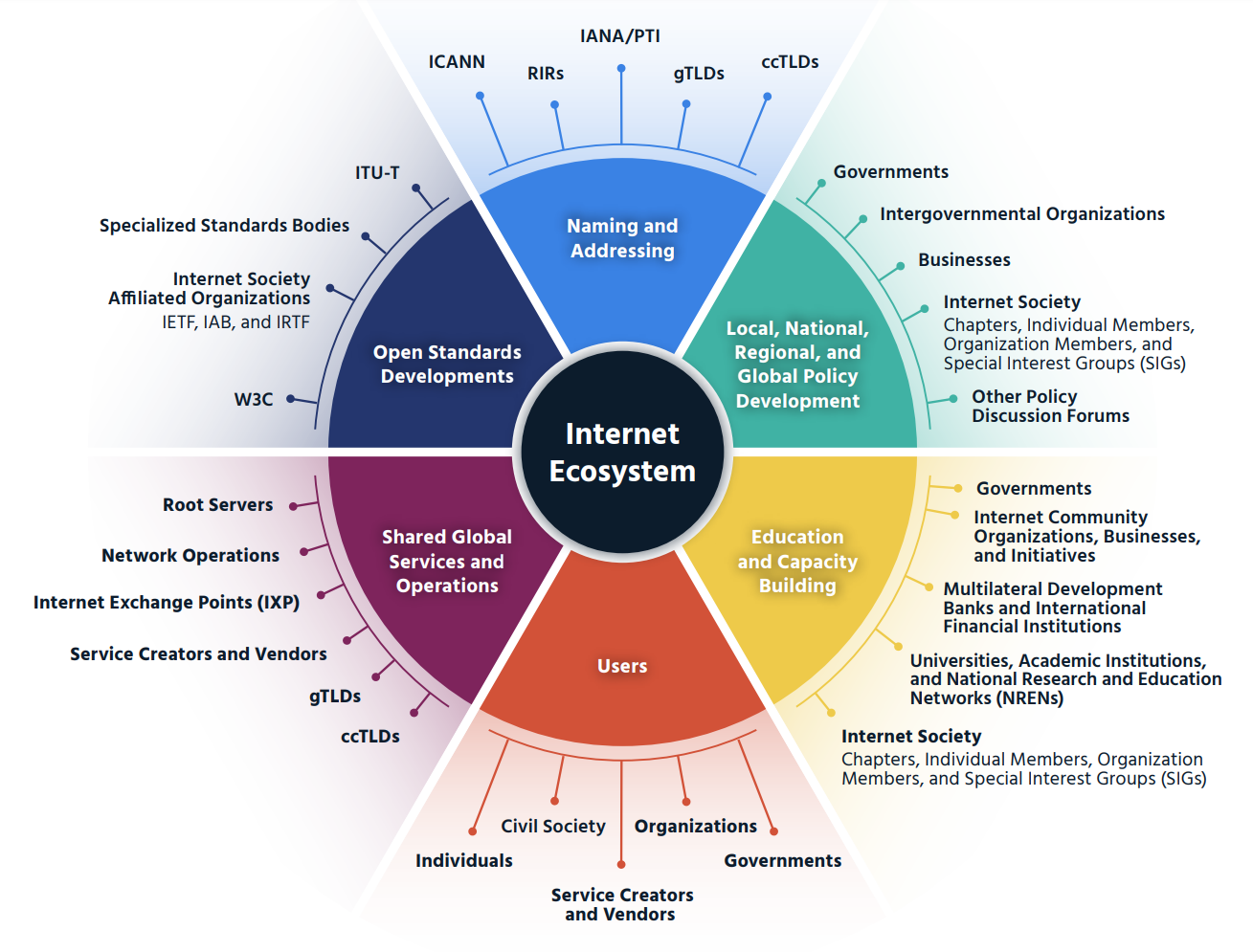
The Architecture of Global Internet Governance: Systems, Regimes, and Multi-stakeholder Dynamics
Global Internet Governance constitutes the complex synthesis of development, planning, and execution activities that facilitate the evolution and utilization of the global network. It is not a centralized authority but a distributed framework involving governments, the private sector, and civil society. These actors collaborate through shared principles, rules, and decision-making procedures to ensure the network’s continued functionality.
The systemic nature of this governance is characterized by the absence of a single, monolithic organization deciding access or operational protocols. This decentralized ethos has been pivotal in allowing the internet to scale rapidly across disparate geopolitical boundaries. The resulting structure is a hybrid of technical coordination and political negotiation.
Historically, the trajectory of this governance can be segmented into four distinct phases, beginning in 1958 and evolving through 1983, 1991, and 1997. Each phase represents a shift in the underlying control mechanisms and the intended purpose of the network. This evolution reflects the transition from closed military-academic experiments to a global utility.
Cómo funciona su sistema digestivo – Emma Bryce
¿Qué es y cómo funciona la INTELIGENCIA ARTIFICIAL?
¿Cómo funciona Internet?
Cómo Funciona un Contactor Bien Explicado | Partes y Funcionamiento
The Evolution of Network Management
From Academic Foundations to Commercial Expansion
Between 1984 and 1991, the network transitioned toward academic proliferation through the NSFNET (National Science Foundation Network). This era was governed by the Acceptable Use Policy, which strictly delineated permissible and impermissible network activities. The NSFNET served as the primary backbone, interconnecting supercomputing centers and research universities across the United States.
The dissolution of Arpanet in 1990 shifted management responsibilities entirely to the NSFNET. By 1991, the National Science Foundation reduced restrictions on commercial utilization, triggering an abrupt expansion of the network. This policy shift enabled the emergence of commercial network providers, fundamentally altering the internet’s economic landscape.
The Multi-stakeholder Framework and the IGF
The Role of the Internet Governance Forum
The Internet Governance Forum (IGF) operates as a multi-stakeholder mechanism designed to be democratic, transparent, and decentralized. Its primary objective is to discuss public policy issues that ensure the sustainability, security, and stability of the internet. The IGF serves as a critical interface between intergovernmental organizations and technical communities.
Guided by the Tunis Agenda for the Information Society, the IGF focuses on accelerating internet accessibility in developing nations. It identifies emerging themes and provides a platform for the exchange of best practices among scientific and academic communities. This ensures that the critical resources of the internet are managed with a view toward global equity.
Capacity Building and Policy Integration
A core function of the IGF is the reinforcement of governance capacities within developing countries by leveraging local expertise. By promoting the principles of the World Summit on the Information Society (WSIS), the forum attempts to mitigate the digital divide. This process involves identifying systemic abuses of the network and proposing multilateral solutions.
Diplomatic Implications and Global Regimes
The internet has fundamentally restructured the social fabric, economic activity, and political organization of contemporary societies. For modern diplomacy, the emergence of a global regime for internet governance represents a new and complex territory. Diplomats must now integrate technological evolution into the broader perspective of foreign policy.
The challenge lies in the intersection of technical protocols and sovereign interests. As the internet eliminates physical distances and reduces sociocultural barriers, the diplomatic action required to manage it must be equally fluid. This necessitates a deep understanding of how technological regimes influence international relations and power dynamics.
Ultimately, the governance of the internet is a reflection of the tension between the desire for a free, open network and the need for regulatory stability. The ongoing dialogue between technical experts and political leaders determines the future of the digital infrastructure that supports everything from smart urban planning to global AgTech systems.
FAQ
What is the primary difference between a centralized government and Internet Governance?
Unlike a centralized government, Internet Governance is a multi-stakeholder process. It involves a collaborative effort between governments, the private sector, and civil society rather than a single authority issuing mandates.
What was the significance of the NSFNET in the history of the internet?
The NSFNET provided the critical infrastructure that connected academic and research institutions. Its decision to relax commercial restrictions in 1991 was the catalyst for the rapid commercialization and global expansion of the internet.
What is the purpose of the Internet Governance Forum (IGF)?
The IGF serves as a multilateral platform for discussing public policies related to the internet. It aims to promote stability, security, and accessibility, particularly focusing on capacity building in developing nations.