The Genesis and Evolution of Internet Governance: From Decentralized Protocols to Platform Hegemony
Internet governance originated not as a formal political framework, but as a technical necessity born from Cold War geopolitical volatility. The catalyst was the 1957 launch of Sputnik, which prompted the United States to establish the Advanced Research Projects Agency (ARPA) to ensure technological superiority. The primary objective was to create a communication system capable of surviving a nuclear strike by eliminating central points of failure.
Early architectural debates centered on the transition from circuit switching to packet switching, a method proposed by Paul Baran and Donald Davies. Unlike traditional telephony, which required a dedicated line between two endpoints, packet switching allowed data to be broken into blocks and routed dynamically across a distributed network. This decentralized logic ensured that if one node were destroyed, the information could simply route around the damage.
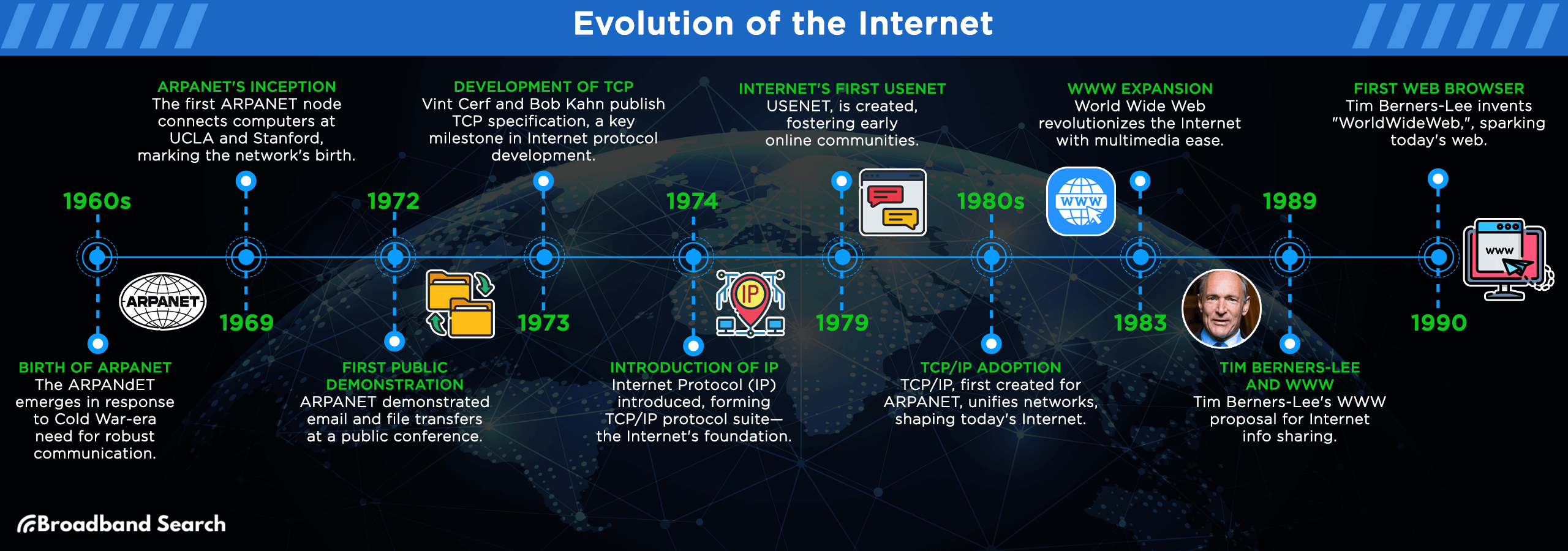
The implementation of the ARPANET in 1969 marked the first operational phase of this vision, utilizing Interface Message Processors (IMPs) to interconnect disparate computer networks. This era was characterized by a collaborative, academic ethos where protocols were refined through the Internet Experiment Note series and Request for Comments (RFCs). The technical governance of this period was essentially a meritocracy of engineers and researchers.
The Entire History of the Internet Explained in 23 Minutes
Internet Evolution: Past, Present, and Future (1960-2100)
HISTORY OF THE INTERNET
The History of the Internet: A Timeline
The Transition to Standardized Interoperability
By the 1970s, the need for a “network of networks” led to the development of the TCP/IP suite by Vint Cerf and Bob Kahn. This protocol suite provided a universal language that allowed different packet-switched networks, such as the French CYCLADES project, to communicate seamlessly. This shift moved governance from the management of a single network to the orchestration of a global interconnection layer.
The 1980s and 1990s witnessed the migration of the network from a military-academic enclave to a civilian platform. The introduction of the World Wide Web by Tim Berners-Lee and the subsequent rise of graphical browsers like Mosaic democratized access. This period of rapid expansion shifted the governance focus toward commercialization and the deployment of massive fiber-optic backbones.
The dot-com bubble of 1995–2000 acted as a financial catalyst, funding the physical infrastructure that now supports modern smart urban systems. However, this commercialization also introduced a tension between the original decentralized architecture and the emerging drive for market dominance. The governance of the internet began to move beyond technical standards into the realm of economic regulation.
The Rise of Multistakeholderism and Political Friction
Formal global discourse on internet governance crystallized during the 2003 World Summit on the Information Society (WSIS) in Geneva. This event introduced the multistakeholder model, which posits that the internet should be governed by a collaboration between governments, the private sector, and civil society. The goal was to bridge the digital divide and ensure equitable access for developing nations.
Despite these frameworks, the implementation of the Tunis Agenda has faced significant challenges, particularly regarding the participation of African nations. Many African governments have noted that geopolitical and historical injustices continue to marginalize their influence in global decision-making processes. This indicates a gap between the theoretical multistakeholder model and the actual distribution of power.
From a sustainable development perspective, this lack of inclusive governance hinders the deployment of critical AgTech and smart infrastructure in the Global South. When governance is skewed toward a few dominant regions, the technological trajectories often ignore the ecological and social specificities of developing economies. True governance must therefore integrate environmental sustainability with digital equity.
The Era of Platform Power and Algorithmic Control
In the current epoch, governance has shifted from the protocol layer to the application layer, characterized by platform power. A small group of entities—the “Big Five” (Google, Apple, Meta, Amazon, and Microsoft)—now control the infrastructural platforms that sustain sectoral services in finance, education, and transport. These platforms are not neutral; they govern user behavior through proprietary algorithms.
This centralization represents a paradoxical reversal of the original ARPANET philosophy of decentralization. While the underlying physical network remains distributed, the layer where human interaction occurs is highly centralized. Algorithmic amplification now dictates cultural visibility and economic opportunity, effectively creating a new form of private governance.
The intersection of AI and platform dominance further complicates the governance landscape, as automated systems now moderate public discourse and organize social interaction. The friction between corporate control, state regulation, and individual freedom defines the current struggle for digital sovereignty. The challenge for future strategists is to reintegrate decentralized resilience into the modern platform economy.
FAQ
When did the technical foundations of the internet begin?
The foundations began in the late 1950s and early 1960s, driven by the US Department of Defense’s ARPA to create a distributed communication network that could withstand nuclear attacks.
What is the difference between circuit switching and packet switching?
Circuit switching requires a dedicated physical path between two points, whereas packet switching breaks data into small blocks that can travel independently across various routes to reach their destination.
What was the significance of the 2003 WSIS summit?
The WSIS summit established the multistakeholder model of internet governance, aiming to include governments, civil society, and the private sector in managing the internet’s evolution and reducing the digital divide.
How has the nature of internet governance changed in the age of AI?
Governance has shifted from managing technical protocols (like TCP/IP) to managing the algorithmic logic and data monopolies of large-scale platforms that control information flow and social interaction.